IPD and the British Council have discontinued the paper-based exam and moved to a computer-based test in many countries. Many students feel at a disadvantage in a computer-based exam just because they are not familiar with the CBT interface.
To get higher scores in the IELTS CBT test, we must get used to its different features and practice accordingly; otherwise, we would be wasting our time and money.
This article will cover everything you should know about the IELTS computer-based test and help you raise your bands in IELTS.
Contents
- Use the highlighting feature
- Try copy-pasting your answers in reading
- Use a note-taking strategy
- Improve your typing speed and accuracy
- New update about IELTS CBT
- Pros and cons of the IELTS computer-delivered test
- What does not work in the IELTS computer-based test
- Level of IELTS computer-based test
1- Use highlighting feature:
This feature can be accessed by pressing right-click on any selected word, and then choosing the option ‘Highlight’. You can also remove the highlighter from any word as well.
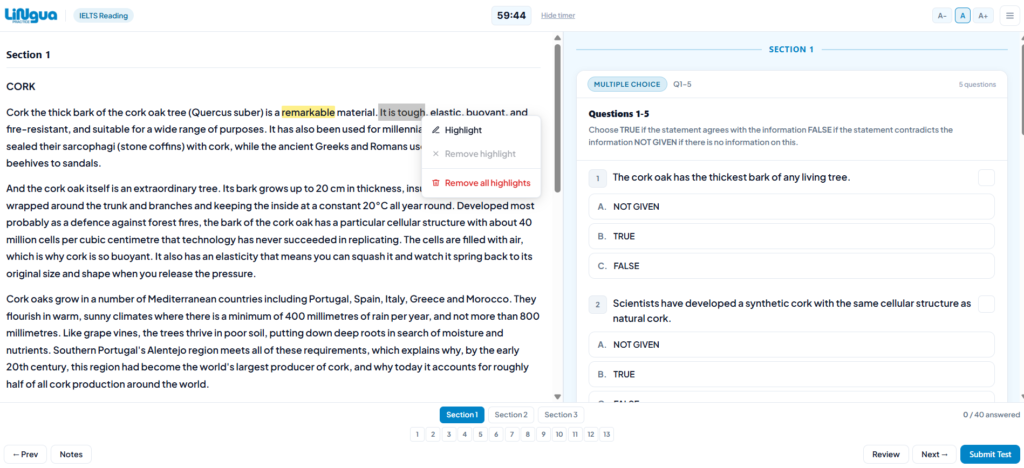
But the most important question is: why should we use the highlighting option in the computer-delivered IELTS?
There are two reasons for this:
(1) It works as signposting or flagging; you flag a certain word, and when you have to search that specific word for a certain question, it becomes easier to find it.
(2) Secondly, some question types, like matching the statement with given names of researchers or people in IELTS reading passage 3, require us to search for their names in the passage. If you have highlighted the names already, then you can save a lot of time while solving this question. Thus, more time means higher scores.
2- Use copy-paste option in IELTS reading:
In case of fill-in-the-blanks in IELTS reading, we can directly copy the answer from the passage and paste it into the answer box. You can do this by using keyboard shortcuts to copy (Ctrl+C) and paste (Ctrl+P) your answers.
This has two benefits:
- It saves our time, so we can finish this question type quickly and spend more time on difficult questions.
- It avoids spelling mistakes, which significantly reduces our scores in both the listening and reading modules.
Remember, this option is enabled by some testing centers, and others don’t. You can confirm this by calling your testing center.
3- Note-taking strategy:
In all three modules of IELTS (Listening, Reading, and Writing), we are given a piece of paper on which we can take notes.
In some question types of IELTS listening, such as matching statements and five choice multiple choice question, we can use a note-taking strategy. Write all the key points discussed in the recording on your paper, and at the end of the recording, they give you 30 seconds to check your answers; you can read your notes and mark the correct answers. Check this example of a student who took notes in IELTS listening.

Also, in the case of IELTS writing, you can plan your whole essay or task 1 properly. This avoids any task response issues, as you would write all the relevant points for your essay. Further, you can write some of the linking words, grammar structures, and examples just to make sure that you do not feel stuck while writing the response.
4- Improve typing speed and accuracy:
Some students are slow writers because they are not used to writing on computers. Thus, when they have to write on the computer screen in IELTS CBT, they are unable to complete their answers on time and lose scores.
Moreover, if someone has a good typing speed, they still make typing errors or spelling mistakes, which reduces scores as well, as IELTS does consider spelling mistakes to be an issue according to their band descriptors in lexical resources criteria.
The solution is that you should practice, practice, and practice. One website that can help you in this regard is this one:
5- New update about the IELTS computer-delivered test:
In a recent update, IELTS, specifically through IDP, has introduced a new policy. This policy has not been followed by the British Council.
According to the new policy of IDP, you can take Listening, Reading, and Speaking on computer, and Writing on paper.
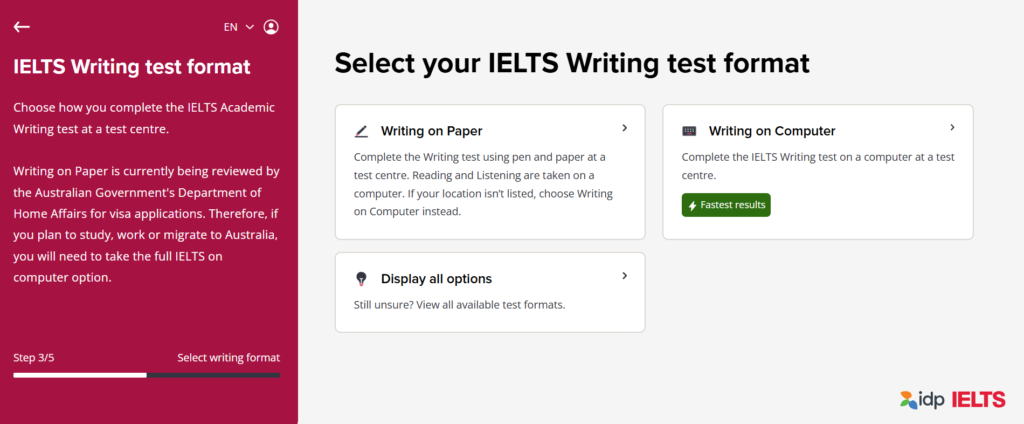
This new policy is a kind of relief for many IELTS test takers who were struggling to write in a short time in the IELTS computer-based test.
6- Pros and cons of the IELTS computer-delivered and paper-based test
Both types of test have their own advantages and disadvantages. Students just need to get used to the test format, which would improve their chances of getting higher scores.
Here are some of the pros and cons of both types of test formats:
| Pros & Cons of the IELTS computer-delivered test | Pros & Cons of the IELTS paper-based test |
|---|---|
| Faster results within 1-5 days | Results are available after or on 13 days of your test date |
| It’s easier to do reading on a computer as the passages and questions are available at the same time on the screen | In a paper-based reading test, you have to turn over the pages again and again to read the questions and passages, which wastes time and confuses the students. |
| You can make edits any time you want in the writing module and get rid of your mistakes in vocabulary, grammar and task response. | In writing a paper-based test, you can remove and rewrite. |
| More test dates are available | There are only one or two dates available in a month |
| Typing mistakes are more likely to occur | More accurate writing, as we are used to this for years |
| In listening, you have to be more attentive, as you need to write the answer immediately | We get 10 minutes extra on the paper-based listening to write your answers |
| You can retake one module if you want | One skill retake is not available |
7- What does not work in CBT IELTS:
In the IELTS computer-based test, you cannot use the find on page option or Ctrl+F. Many websites allow this feature, and students practice using it, which ends up in poor results in the actual test.
To practice according to the real exam interface, click on the button below:
8- Difficulty level of IELTS CBT test:
It’s a common misperception made by IELTS students that the computer-based test is difficult or easier than its counterpart.
Both tests are equal when it comes to difficulty level, as the content and type of questions are the same in both tests as well.
Conclusion
To conclude, we can confidently say that IELTS CD has some advantages over the paper-based exam when it comes to the reading and writing modules. Though some students may struggle with typing issues, they can overcome this through practice.
Moreover, with the new exam about in CBT test, students may find it easier to tackle the writing module, especially those who have a slow typing speed.
Finally, we would say that consistent practice is the key to being successful in the IELTS test regardless of which format you choose.
Frequently asked questions
Apart from the above questions that we have answered in depth, some students also ask these questions frequently:
1- Can I switch to a paper-based exam after paying for computer-based or vice versa?
There are two scenarios in this case:
(i) Before payment confirmation: In this case, you should simply cancel your current exam booking through the exam portal and book a new one.
(ii) After payment confirmation: Different policies are adopted by testing centers and bodies across the world. Therefore, in this scenario, you should contact your test center through email for more accurate information and procedure.
2- What’s the price of the IELTS computer-based exam? Why is it lower than the paper-based exam?
The current price of the computer-based exam is $215 to $350 USD, depending on the region and test center location. The reason the paper-based exam costs more than the CBT exam is that, in the case of the paper-based exam, the testing body needs to hire physical examiners to evaluate your responses in each section, which is done on a computer in the CBT exam. This does not mean that AI evaluation is involved in checking the IELTS exam.
3- Which is the most realistic interface of a computer-based IELTS exam?
The website which has nearly similar interface to the actual exam are IELTS Prep and Practice and Linguapractice. Both websites have almost similar features as the real test.
4- Can I navigate freely from one section to another within each module?
Yes, you can move from one section to another. For example, in IELTS listening, you can move from Part 1 to Part 2 and so on, and then back as well.
5- Will I be provided a laptop or a desktop computer in a computer-based exam?
It depends on the testing center. Some of them provide a desktop computer with a keyboard (old-fashioned), and others provide a laptop with a bit of comfortable typing experience.
6- Can I write and delete my answers anytime in the test?
Yes, in reading, listening, and writing, you can make edits in the written text any time you want.

Written By: Hamza Ahmad
I’m an English language trainer with 3+ years of experience in IELTS, helping students achieve scores as high as an 8.0 overall band. A published contributor to Modern English Teacher (MET), I founded IELTS Prep and Practice to help students hit their target scores through proven strategies and personalized coaching.
Contact Now