Quick Links: 5.5 Band Sample, 6 Band Sample, 6.5 Band Sample
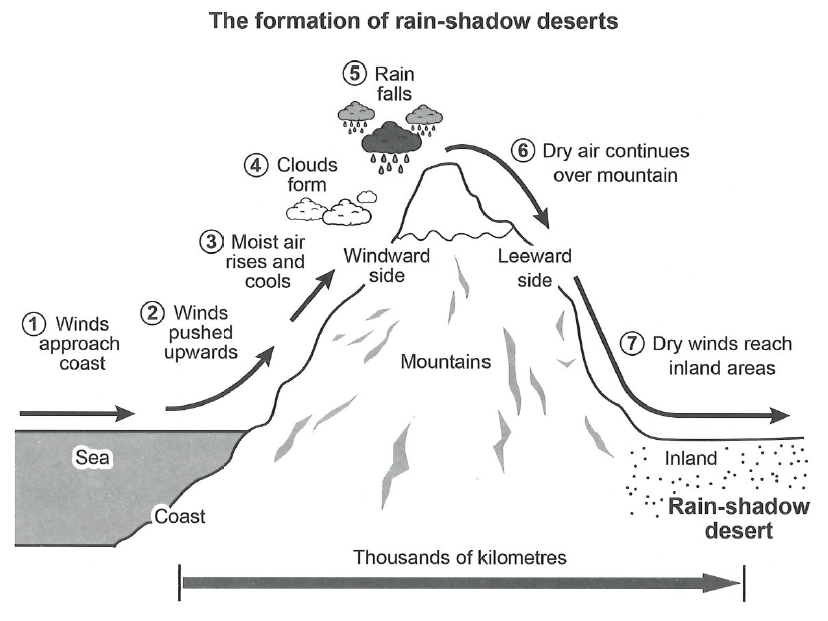
Read the sample process diagram answer on the topic: The diagram below shows how one type of desert, known as a rain-shadow desert, is formed.
The diagram below shows how one type of desert, known as a rain-shadow desert, is formed.
Summarise the information by selecting and reporting the main features, and make comparisons where relevant.
Band Score: 5.5 Bands
The diagram illustrates the production of rain shadow effect dessert.
Overall, there are seven different stages initiating from air advancing coast to the dry air approaching noncoastal areas for rain shadow effect desert.
Firstly, air started to move from the seacoast towards the mountain. Secondly, the wind shoved upwards and converted into moist air that rises and began to cool slowly. After this, the moist air is converted into clouds at upward side. When these clouds become heavy with moisture, the rain started to fall over the mountain. Then, the dry air with very little moisture proceeds over the mountains and leaves the mountain to reached the non-coastal areas. It is because mountain has created a barrier for moist air to reach deserted areas. At this stage, the rain shadow desert is formed with thousands of kilometers distance between seacoast and inland desert.
To conclude, this figure displays the process of rain shadow desert with total seven stages starting from air ascending towards the mountain to dry air approaching midlands area.
Written by an IELTS Candidate
Band Score Analysis (5.5):
- The paraphrasing is correct, but the word ‘effect’ is not needed.
- There are spelling issues [dessert]
- The student has used some linking words, but she should try not to use them in an order like Firstly, Secondly, After this.
- There are some missing articles. Here are the corrections: [a* rain shadow effect] [the* mountain has create] [the* seacoast and inland] [the* total seven stages]
- Some word formation mistakes exist as well. These are the mistakes: [to reach deserted* areas] [mountain to reached* the non]
- The student should not use informal words [shoved, a better word here would be: pushed]
- There are some missing prepositions. Here are the corrections: [air advancing from the* coast]
- Wrong choice of word [midlands], not a synonym of inland areas.
- A key point is missing [there is no mention of windward and leeward side of the mountain]
Band Score: 6.0 Bands
The diagram illustrates how rain-shadow desert comes into existence.
Overall, the formation of rain-shadow deserts is a natural process involving seven stages starting from winds swinging across the sea and ending with the desert being formed after dry winds reach inland areas.
Firstly, the winds coming from the sea approaches the cost. These winds are then pushed upwards after being blocked by the mountains by its windward side. As these winds raises, it becomes moist air, which starts cooling down. Due to this, the clouds are formed that starts pouring rain over the mountains. After the rainfall, the dry air continues over the mountains on its leeward side, and it reaches the inland areas. The winds have travelled thousands of kilometers so far when it reaches the inland areas. Finally, the rain-shadow desert is formed.
Written by an IELTS Candidate
Band Score Analysis (6.0):
- The student has written around 136 words, though he has written about all the important stages of the diagram, which did not affect his task response too much.
- The paraphrasing is accurate, but the word ‘comes into existence’ is not suitable here. A better choice would be words like develop, created, formed, etc.
- The student has used different cohesive devices (linking words like firstly, finally, and usage of substitution is good) accurately, which improved their cohesion and coherence score.
- There are several grammatical errors, mainly of subject-verb agreement and punctuation.
- In order to raise the score, the student should write 150 words (can write a conclusion, just to fulfil the word count limit), remove all grammatical mistakes, and improve paraphrasing.
- Word formation errors are also present [winds raises].
Band Score: 6.5 Bands
The diagram illustrates the process of rain-shadow desert formation.
Overall, it is a linear process with seven stages, starting from wind formation across the coast to rain-shadow desert formation after the dry wind reaches inland.
During the first stage, the winds coming from the sea approach the coast. These winds are then pushed upwards after hitting by the windward side of the mountains. As these winds rise, they become moist air that keeps rising and cools down. The cold air then forms the clouds; as a result, it starts to rain at the moment when the clouds reach the peak of the mountain. Then, the dry air starts coming down from the mountain on its leeward side, and it finally reaches the inland areas. Here, the dry air forms the rain-shadow desert because of the dust particles present in the inland atmosphere. The whole process occurs after the winds have travelled thousands of kilometers from the sea towards inland areas.
Written by an IELTS Candidate
Band Score Analysis (6.5):
- The paraphrasing is done accurately, though it could be improved.
- The vocabulary used is appropriate to the task.
- The student has discussed all the stages in a detailed and logical manner.
- There are no major grammar mistakes, but the grammatical range could be improved by using complex and compound sentences.
- An informal word is used [hitting]. The student could have used words like obstructed.
Read this article for more tips on the IELTS writing task 1 process diagram type question.

Evaluated By: Hamza Ahmad
I’m an English language trainer with 3+ years of experience in IELTS, helping students achieve scores as high as an 8.0 overall band. A published contributor to Modern English Teacher (MET), I founded IELTS Prep and Practice to help students hit their target scores through proven strategies and personalized coaching.
Contact Now