Sentence completion or fill-in-the-blank type questions can be solved correctly using the three-step method that is discussed in this article. Blanks are the easiest question in IELTS reading, but some students still struggle to find the correct answer. However, this blog will explain an easier approach to this blank-filling question, so that you can achieve higher scores.
Step 1: To solve reading blanks, read the question instructions first:
In IELTS reading, in case of a gap-filling question, there are different question instructions given with the question statement, according to which we have to write the answers. Here are those instructions, and what do they mean:
(i) What does ONE WORD AND/OR A NUMBER ONLY mean:
This means that in the answer to your questions, you can write in this way:
- Food ✅
- 1 July✅
- 15✅
All the above answers will be correct.
It will be wrong if we write the answers in this way, when the instructions say to write one word and/or a number only:
- Fast Food ❌
- 15 July 2020 ❌
Both these answers are wrong because the first one has two words, and the second has two numbers, which is not allowed according to the question instructions.
(ii) What does ONE WORD ONLY mean:
According to this, we can write only one word in the answers, like:
- Food ✅
- Car ✅
- List ✅
But now, you might be asking if we can write a number in this case or not. We can, but not numerically; check the example below:
- Fifteen ✅
- 15 ❌
(iii) What does Write NO MORE THAN TWO WORDS & NO MORE THAN THREE WORDS mean:
In these instructions, you have to be careful. You need to focus on the context of the sentence. Remember, fill-in-the-blanks or sentence-completion-type questions basically require us to complete the meaning of the sentence. So, you can only complete the meaning by inserting the right number of words, which could be one, two, or three as well. In this case, if you write answers like this, it may or may not be correct:
- Fast food ❌ ✅
- The blue car ❌ ✅
- Fast ❌ ✅
The reason I have put correct and wrong icons with the above answer examples is that the answer could be correct or wrong as well; it totally depends on the context of the sentence. Check an example question below:
Paragraph – taken from Cambridge IELTS GT 13 Test 1

Question Statement:
Make sure the _ _ _ _ _ _ are on inside the vehicle.
The correct answer in this case is:
- Cab lights ✅
- Lights ✅
You can see that the answer in the paragraph is two words. But, if we look at the question statement, the word ‘vehicle ‘, which is a synonym of ‘cab ‘, is already there. So, even if you do not write the word ‘cab’, the meaning of the sentence is still complete.
The bottom line is that when they say ‘write no more than two words or no more than three words’, in this case, you need to focus on the meaning of the sentence and understand the context.
Here’s a quick overview of what we have discussed above:
| One Word AND/OR A Number Only | One Word Only | No More Than Two Words | No More Than Three Words | |
| Correct Answer | Food, 15, 15 July | Car, Pineapple, Thirteen | Fast Car, Car | Fast Car, Car, Over the moon |
| Wrong Answer | Delicious Food, 15 July 2020 | 15, Salty Fish | Very fast car, 15 | 15 |
Now that you know what those question instructions mean and how to write the answers, let’s move toward the second step.
Step 2: Understand and highlight the keywords of the gap-filling question statement:
Each statement of gap filling has certain keywords; you need to highlight them first. Then, read the whole question statement to understand what the sentence means or what is actually missing in the sentence. Check the example below of how we highlight the keywords:
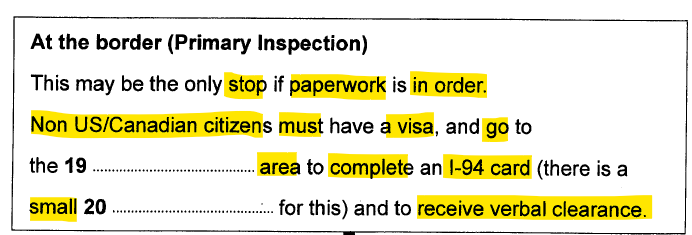
After you have highlighted and read the question statements, you need to find them in the passage. Remember, these sentence completion or blank-filling type questions are in an order or sequence in the passage, so if you find any of them, you will know the order of all other questions as well.
Step 3: Compare the question statement and paragraph information:
Once you know where your question is in the passage, you have to compare the information in the question statement with the passage to find out what the answer is.
While comparing, you need to focus on the context of both, keep the question’s meaning in your mind, and read the passage information. Check the analysis below:
Question: Make sure support is made available if any _ _ _ _ _ _ exist as to the team member’s ability to do the work.
Analysis: Here, the question is basically telling us that ‘a support should be available if one team member cannot work due to a certain reason. We need to find the reason.
Paragraph: If you have concerns that someone doesn’t have the skills to do a good job (or they tell you this outright), make sure that you offer some help.
Analysis: In the paragraph, they are mentioning that if you think/have concerns (reason) someone does not have the skill to do the job, then make sure you offer some help or support. So the missing word or answer is concerns.
Now that you have found the answer, write it correctly using the same spellings and move to the next question. Repeat these three steps for every fill-in-the-blank question to answer all of them correctly.
Conclusion
Solving the sentence completion question totally depends on how well you understand the question and then write the answer correctly according to the question instructions. Our three-step method will ensure that you never answer this question in the wrong way, but practice is the key.
Frequently Asked Questions
Here are some common questions or queries that you may have related to blank filling:
Yes, they are always in sequence in the passage.
We need to do the questions in order, so whatever comes first, do it first, and do the other questions later.
These are the easiest type of questions in IELTS reading.
In this case, you should move to the next question and come back to this at the end to save time.
Always read the question statements first, according to our three-step method, to find the answers easily.

Written By: Hamza Ahmad
I’m an English language trainer with 3+ years of experience in IELTS, helping students achieve scores as high as an 8.0 overall band. A published contributor to Modern English Teacher (MET), I founded IELTS Prep and Practice to help students hit their target scores through proven strategies and personalized coaching.
Contact NowLast Updated on 18 July 2026