To write the letter in your IELTS General Training test correctly for higher scores, you must write the introductory sentence first, explain each bullet point separately, include salutations and closings, and show a range of grammar and vocabulary. Moreover, remember that the content or your language may vary according to the letter type: Formal and Informal. This blog will explain all those points in detail to help you write a perfect high-scoring IELTS letter.
Follow these instructions one by one, and by the end of the blog, you will be fully informed about what a good IELTS GT letter – formal or informal – should have.
1- Find out what type of letter it is: Formal or Informal
In IELTS General Training Writing Task 1, we have two types of letters, and each serves a different purpose from the other. This differentiation is made so that you can actually see how to respond to such formal or informal situations/letters in your daily life.
Let’s look at both one by one:
(a) Formal Letter
A formal letter is written to a company, organisation, or someone who works in a professional environment. It could be a manager at a company where you are currently working, want to work, need some information from someone, or report an issue to someone. Here are a few examples of formal letters that we see in the real IELTS GT writing module:
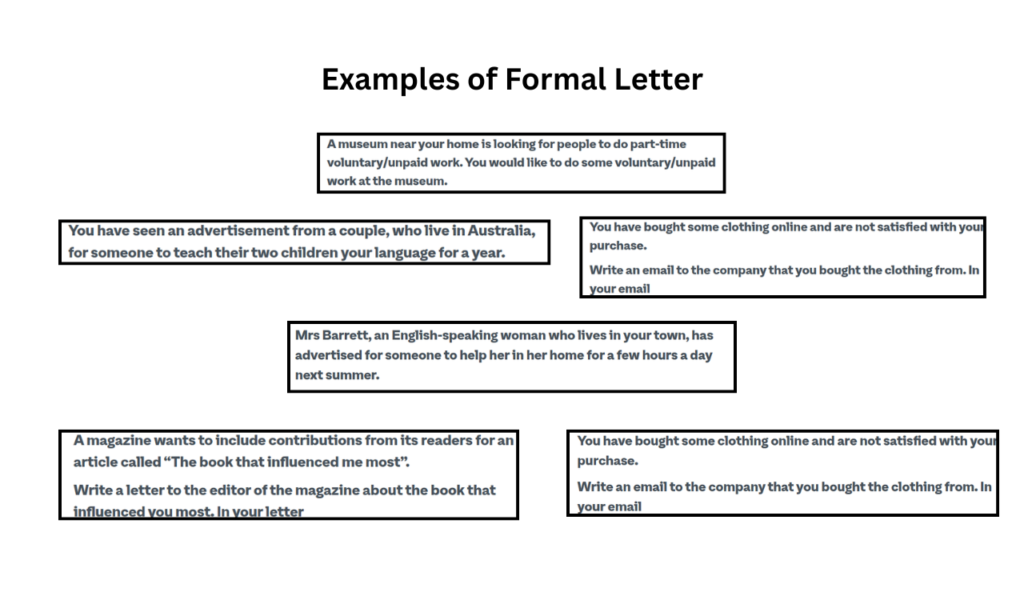
If you look at each of the question statements in the image above, you can see that all of them are related to a professional environment, in which you are either asking for information or giving your own personal information.
Now, to summarize, a formal letter is one in which:
- Professional Recipient: The prompt addresses an official, organization, manager, editor, landlord, or stranger rather than a personal contact.
- Action-Oriented Purpose: The goal involves a formal administrative task, such as filing a complaint, applying for a position, requesting official permission, or making an inquiry.
- Official Directive Verbs: The prompt uses formal verbs like apply, request, enquire, complain, highlight, recommend, inform, or urge.
- Institutional Context: The background scenario involves a workplace, business establishment, school administration, local council, or public issue.
- Structured Salutation and Sign-off Requirements: The task implies a standard business structure requiring formal greetings like Dear Sir/Madam.
(b) Informal Letter:
These are the types of letters we mostly write to those people whom we already know or have built a personal relationship with for quite a long time. So, most probably you will be writing it to your friend. Look at these examples:
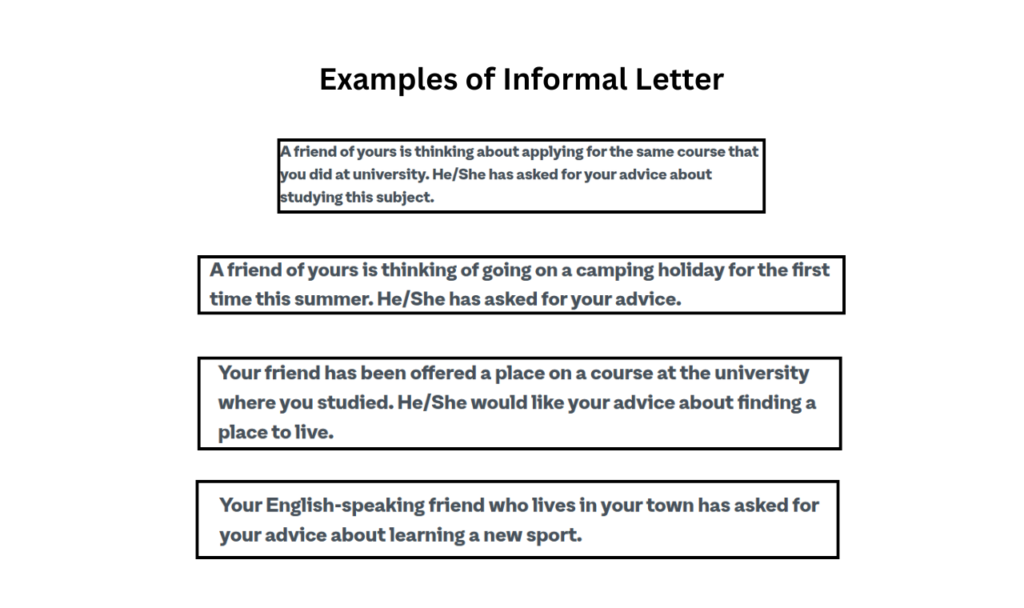
In all those questions, you can see that you are writing them to your friends. So, you can identify that a letter is an informal one if:
- Personal Recipient: The prompt addresses a friend, family member, classmate, pen pal, or someone with whom you share a close relationship.
- Social or Relational Purpose: The goal centers on sharing personal experiences, expressing emotions, giving advice, describing a recent trip, or catching up.
- Informal Context: The scenario involves personal events, holiday plans, family celebrations, or casual social gatherings.
- Relaxed Salutation and Sign-off: The task implies warm, friendly greetings such as Dear [First Name] etc.
Now that you have understood what a formal and informal letter looks like, you might be asking what we should do with it? Like, what difference does it make when I actually write the letter? What are some points that I should follow or avoid when writing these letters?
Main differences between IELTS Formal and Informal Letter:
Check this comparison table to learn some important points that you should keep in mind when writing any one type of letter:
| Important Points to Follow | IELTS Formal Letter | IELTS Informal Letter |
| Who you are writing to | Bosses, managers, company staff, landlords, or people you do not know. | Friends, family, or close acquaintances. |
| How to start | Dear Mr. Smith, (if you know the name) or Dear Sir/Madam, (if you do not know the name). | Dear John, or Hi Sarah, |
| Introductory sentence | State the reason immediately: “I am writing to complain about…” or “I am writing to ask for…” | Friendly opening: “I hope you are doing well.” or “It was nice to hear from you.” Then mention the reason. |
| Language and words | Polite, clear, and serious. Use full words and business-like phrases. Examples: • “I would like to request…” • “Please accept my apologies…” • “I am writing to inform you…” | Friendly, relaxed, and natural. Everyday words and common expressions are okay. Examples: • “I wanted to ask if…” • “I’m really sorry about…” • “Just wanted to let you know…” |
| How to end | Yours sincerely (if you used a name) or Yours faithfully (if you used Dear Sir/Madam), then your full name. | Best, Warmly, or See you soon, followed by just your first name. |
Once you know what type of letter you have, you need to focus on writing the letter and write according to the correct structure.
2- IELTS GT Writing Task 1 Structure
Writing the letter according to the correct structure is crucial for a good score. It helps you to organise your information in a logical way. Once the information or sentences are cohesive, there are fewer chances of writing something irrelevant to the question or a poor task response.
IELTS Letter (Formal & Informal) has the following structure:
- Use Salutations
- Write an introductory sentence according to the letter type
- One body paragraph for each bullet point
- Then closures.
Let’s discuss each of these one by one:
(a) Salutations in IELTS General Training Letter
The openers or salutations will vary according to the type of letter, as we have discussed briefly in the table above. Mostly, in an IELTS GT writing task 1, the openers are written with the question; take this example:
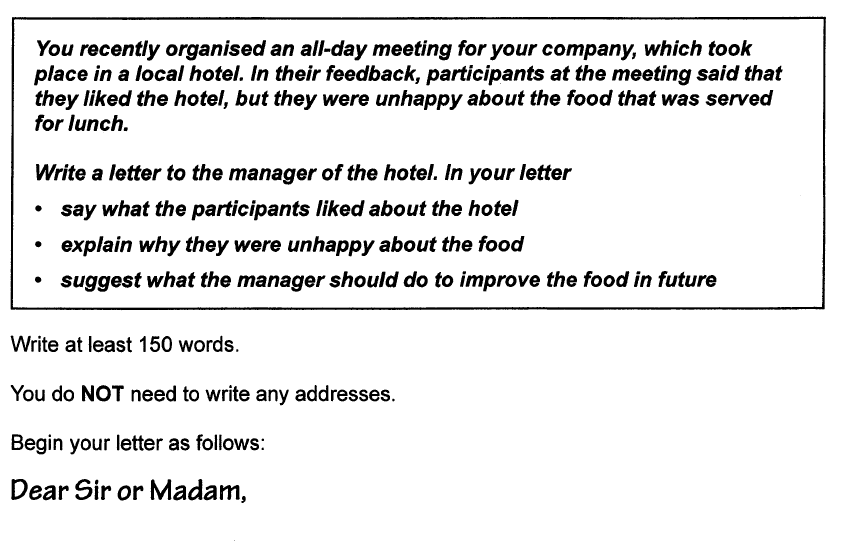
This is a formal letter because you are writing the letter to someone you do not know. The question has told us that we must begin the letter by writing ‘Dear Sir or Madam’, so we will do this and begin the letter accordingly. We cannot write ‘Dear Manager’, ‘Dear Hotel Manager’, or in any other way; it will be considered wrong and decrease our score.
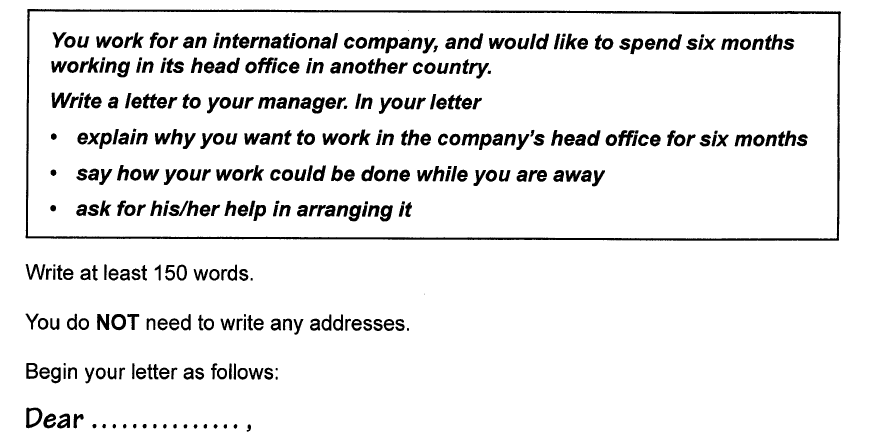
Similarly, if you look at the question above, it is an informal essay as we already know who the company manager is. So, the question is telling us to write the name of the manager; therefore, the opener in this case would be: Dear Alex, Dear Adam, Dear Sarah, etc, whatever the name of the manager is.
After writing the salutations or openers, you have to write the introductory sentence:
(b) Introductory Sentence in IELTS GT Letter
The introductory sentence tells or introduces the purpose of the letter. It describes to whom we are writing the letter and for what reason.
In an IELTS letter, you will write the introductory sentence according to the main question statement. It is necessary to write this sentence because, according to the IELTS writing band descriptor for band 7, we need to present a clear purpose with a consistent and appropriate tone.
Here is a few examples:
Question:

✅ Good Introductory Sentence:
I am writing this letter to complain about the rubbish collection system in the area, which is malfunctioning and causing inconvenience to local residents.
Why is it good? The sentence has covered all the important points given in the question by accurate paraphrasing.
❌ Bad Introductory Sentence:
I am writing this letter to explain that the collection system in the area is not working properly and causing problems for me and my neighbours.
Why is it bad? This example is bad because it copies exact phrases from the question itself without properly rephrasing them. Also, it does not mention which collection system we are talking about.
(c) Explain each bullet point in a separate paragraph
According to the coherence and cohesion part of the IELTS writing band descriptors, in order to get a band 8 in this part of the scoring criteria, the letter “uses paragraphing sufficiently and appropriately”.
That means we should never discuss all the bullet points given with the question in one single paragraph. We must organise our content in separate paragraphs, with each one of them focusing on one specific idea.
Take this example:
Question:
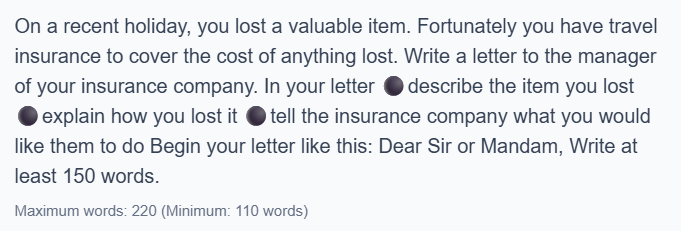
❌ Poor Paragraphing:
Dear Sir or Madam,
I am writing to notify you that I lost my baggage during my vacation in Paris at 21st august.
Firstly, my baggage contained several items, such as a laptop, a key, and some clothes. In addition, there was a file that is very important for my future project. However, I have an abstract of it. So, it won’t cause any problems. During my trip to Paris, I took a private taxi that helped me to visit almost all the popular parts of that area. Personally, I believe that I lost it while visiting the Eiffel Tower.
I would therefore appreciate it if you could find a solution to locate my baggage or offer me appropriate compensation, such as funds to buy a new laptop and other items. I hope you will take my concerns seriously and ensure that the insurance will be provided without any delays.
I look forward to hearing from you.
Your faithfully,
Kamal.
Why is it poor paragraphing:
- The letter lacks separate paragraphs for each bullet point
- Two bullet points [when you lost it and the item you lost] are explained in one single paragraph
- The response lacks the use of cohesive features to make it more organised.
✅ Good Paragraphing:
Dear Sir or Madam,
I am writing to report a lost item, which is very valuable to me.
It happened last Sunday when I was travelling to the Niagara Falls with my family. I have insurance policy from your company for almost six months. My policy number is TWRY682389.
I lost the digital camera. I still remember I had it throughout my trip, but upon returning from Niagara Falls, I noticed that the camera was missing. The camera is dark blue, and it is equipped in a white bag. I travelled by a train so I lost it when we caught the train from Niagara Falls to Toronto Union Station in the evening. The departure time was 5 pm.
I request you to locate the camera as it has GPS, and I have already provided the information while insuring the camera under your company. Could you also please let me know how long it would take to search for the camera? Also, please tell me the next step you would take if the camera is not found.
I hope you will take this matter into consideration. I look forward to hearing from you soon.
Yours faithfully,
Gulshan
Why is it good paragraphing:
- The student has answered each bullet point in a separate paragraph.
- The purpose of each paragraph is clear.
- There are some missing details since our main focus is on paragraphing, so in that regards, the response is a good one.
(d) Closures of the IELTS Letter:
The last part of the letter is the closing. It also differs according to the type of the letter:
1- If it is a formal letter, then you should use ‘Yours faithfully’ and then write your full name.
2- If it is an informal letter, then you should use ‘Best’, ‘Warm Regards’ or ‘Yours Friend’, and then write your first name.
Useful tips for IELTS Letter Writing:
Here are some common tips and mistakes you should avoid while writing a letter in the IELTS Writing General Training exam:
- Read the question carefully: Before you start writing the letter, read the given question two to three times to understand what the examiner really needs in this task or question. Focus on whom you are writing, what the purpose is, and what ideas or reasons you need to discuss.
- Include complex and compound sentences: To show a range of your grammar, we must bring variation in our sentence structures, which gives us higher scores.
- Write a cohesive response: You can do this by making separate paragraphs for each bullet point, and then use different cohesive devices (linking words, referencing and substitution) in your response.
- Avoid using unrelated vocabulary: The vocabulary you use will depend on your letter type. For example, if it’s an informal letter, you may write “I found a spot for you at a company”, but this would not be acceptable in a formal letter, where you should write “I found a suitable role for you at the company”.
- Write a clear introductory sentence.
- Maintain a consistent language and tone throughout the letter.
Practice IELTS GT Writing Task 1 for FREE:
You can use our AI + Expert feedback writing evaluation platform to practice the IELTS letter for your General Training exam and get proper feedback for each of your mistakes and practice within the time conditions and real exam interface.
Other resources such as Liz IELTS, Cambridge IELTS books, and IELTS Formal and Informal Letters sample answers can also be helpful for you in your IELTS GT exam preparation.
Conclusion
To get a high score in IELTS General Training Writing Task 1, you need to use a clear structure and choose the right style of language. First, decide if the letter is formal or informal so you can use the correct greeting, words, and ending. You should always start with a clear opening sentence and write a new paragraph for every bullet point in the question. Try to avoid copying words directly from the question, and use different kinds of simple and compound sentences. Finally, practicing regularly with good feedback will help you feel confident and achieve the score you need on your exam.
Frequently Asked Questions
No. The tone depends entirely on who you’re writing to. Reddit users frequently ask whether GT Task 1 is always formal. The answer is that it can be informal or formal depending on the recipient and the situation described in the prompt.
You must write at least 150 words. Reddit users often worry about upper limits — some report writing 250–300 words and ask if it hurts their score. While there is no official maximum, the general consensus is to aim for 150–200 words for letter-writing tasks. Going significantly over may cost you time and could lead to verbosity, but it won’t automatically reduce your score if you stay relevant.
You do not need to use your real name — you can use any name you want. However, you must include a proper sign-off expression (e.g., “Yours sincerely,” “Best regards,” “Yours faithfully,” etc.). Forgetting to sign off entirely can hurt your score. Also, you need to include your address unless required or demanded by the question.
Yes. You must address all bullet points. Reddit users who applied for remarks (EOR) note that getting a low Task Achievement score often means either misunderstanding the situation or failing to address one or more bullet points. Each bullet point should be clearly covered in your letter, ideally one per paragraph.
A common Reddit question is whether to use 3 or 4 paragraphs. For GT Task 1 (letter writing), the safest and most recommended structure is:
(i) Paragraph 1: Opening/purpose of the letter
(ii) Paragraph 2: Address bullet point 1
(iii) Paragraph 3: Address bullet point 2
(iv) Paragraph 4: Address bullet point 3 + closing

Written By: Hamza Ahmad
I’m an English language trainer with 3+ years of experience in IELTS, helping students achieve scores as high as an 8.0 overall band. A published contributor to Modern English Teacher (MET), I founded IELTS Prep and Practice to help students hit their target scores through proven strategies and personalized coaching.
Contact NowLast Updated on 15 August 2026