Mastering the IELTS Listening test can feel difficult, but you can achieve a high score with the right approach. In this guide, you will discover the most effective tips and strategies to help you get a Band 9 in IELTS Listening. You will learn how to prepare before each recording begins, including reading the questions carefully, highlighting key words, and predicting possible answers. We will also cover essential advice on how to avoid traps and write your final answers accurately so that spelling mistakes do not reduce your score.
Now, to understand how to follow all those important strategies, read this blog:
Tip 1 – Read the question instructions first:
Now, if you are solving any type of question in the IELTS recording, you must read the question instructions first to understand what they expect us to write in the answers. For multiple-choice and matching statement type questions, it is simple, as we will just choose a correct option. However, in case we have to write the words as in Part 1 and Part 4, mostly for blank-filling type questions, we have to be careful, as there are different instructions given in this case. Here are some common instructions given with sentence completion or blank-filling type questions:
(i) What does ONE WORD AND/OR A NUMBER ONLY mean:
This means that in the answer to your questions, you can write in this way:
- Food ✅
- 1 July✅
- 15✅
All the above answers will be correct.
It will be wrong if we write the answers in this way, when the instructions say to write one word and/or a number only:
- Fast Food ❌
- 15 July 2020 ❌
Both these answers are wrong because the first one has two words, and the second has two numbers, which is not allowed according to the question instructions.
(ii) What does ONE WORD ONLY mean:
According to this, we can write only one word in the answers, like:
- Food ✅
- Car ✅
- List ✅
But now, you might be asking if we can write a number in this case or not. We can, but not numerically; check the example below:
- Fifteen ✅
- 15 ❌
(iii) What does Write NO MORE THAN TWO WORDS & NO MORE THAN THREE WORDS mean:
In these instructions, you have to be careful. You need to focus on the context of the sentence. Remember, fill-in-the-blanks or sentence-completion-type questions basically require us to complete the meaning of the sentence. So, you can only complete the meaning by inserting the right number of words, which could be one, two, or three as well. In this case, if you write answers like this, it may or may not be correct:
- Fast food ❌ ✅
- The blue car ❌ ✅
- Fast ❌ ✅
The reason I have put correct and wrong icons with the above answer examples is that the answer could be correct or wrong as well; it totally depends on the context of the sentence.
Tip 2- Read the questions before recording starts:
In every part of the listening module, there is some extra time given at the start, in between, and at the end as well. It is usually around 30 seconds. In this time, the speaker tells us to read a certain number of questions. Therefore, you should not just sit and wait for the recording to start. Instead, read those questions and try to understand the given information.
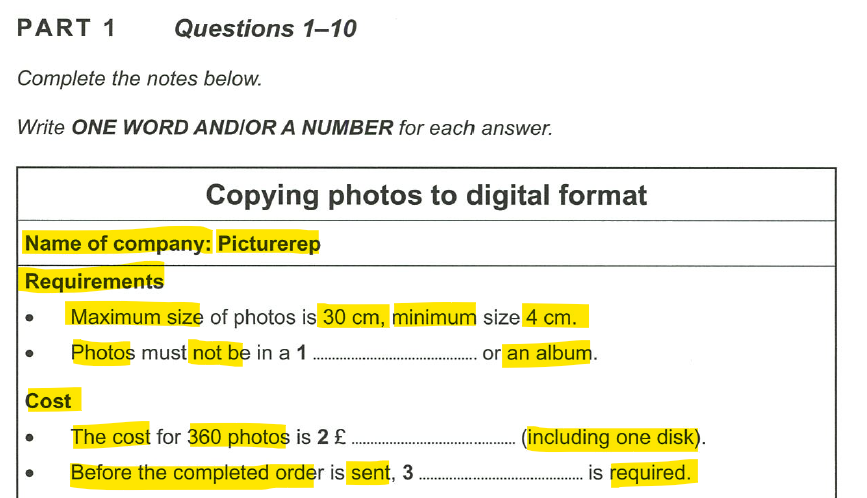
Tip 3: Start highlighting the keywords:
Firstly, you should understand what the keywords are. The keywords are words such as verbs, nouns, adjectives, and adverbs. These parts of speech are always used in the question section of the listening module.
You might be thinking: why do we need to highlight them?
Remember that the wording you see on the question paper will not be similar to the wording they use in the recording – this is what we call paraphrasing. So, you will hear a paraphrased version of the question section in the recording. However, this does not mean that they will paraphrase every single word written in the question section; there will be some words that they cannot paraphrase, such as common nouns (football, shoes, umbrella) and verbs (compete, learn).
Therefore, if you have highlighted the keywords, you will be able to easily track the conversation using those keywords that they cannot paraphrase. This will help you to stay focused on the recording and avoid missing any questions that result in poor scores.
Check this example:
Tip 4: Understand the question statements:
As you are highlighting the keywords, you should try to understand what the question is saying or what the question basically means.
You can do this by translating the question statement into your native language and drawing a contextual meaning of the sentence. To do this effectively, it is very important that you have a good vocabulary and comprehension skills.
Tip 5: Try to predict the answers:
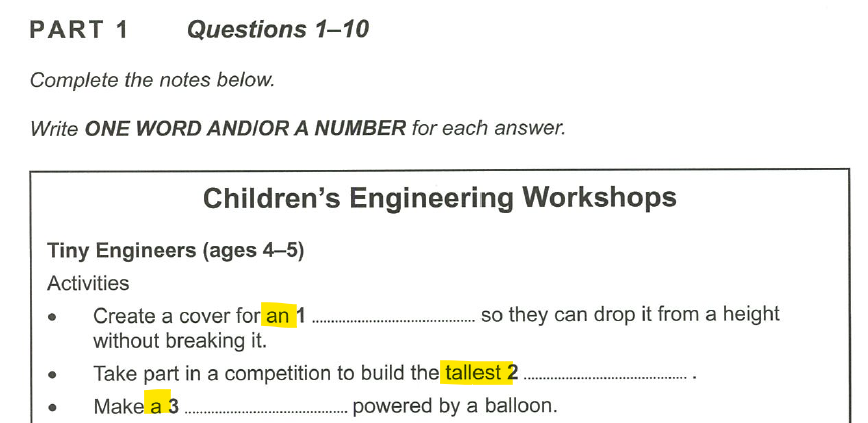
After you have read the question statements and highlighted the keywords, you need to focus on the blanks. Focus on the articles, prepositions, and other parts of speech used with the blank.
For example, in the question below, they have used the article ‘an’ with the blank; it means that the answer is a noun, as we always use articles with nouns. So, in this case, we can predict that the answer is a noun and that it is related to something that would not break after being thrown from a certain height. Also, the noun should start with a vowel.
Similarly, focus on other parts of speech, such as adjectives and gerunds, being used with the blanks to predict what the possible answer could be.
Tip 6: Memorize the given information:
The sole purpose of the listening module is to listen and find the answer. You cannot read and listen at the same time, and if you try to do that, you will lose your focus on the recording and start getting the wrong answers.
Therefore, before the recording starts, you should memorize every single piece of information written in a specific question section, so that you can be fully focused on the recording and easily find the correct answers. This is especially important for Part 2 and Part 3 questions.
Tip 7: Be careful with the traps:
In the IELTS listening module, whenever you see that you have to write a number, a word, or a name of the day, there will be a trap.
Here’s how they lay a trap. Let’s look at the question below. What they will do here is that first they will say, ‘The price of this product is $10, and then they will discuss more about the product, and at the very end, they will say, ‘We are offering a discount’, so you can pay only $ 5. Here, the correct answer will be $5, not $10.
So, be careful with such traps and choose the correct answer.
Tip 8: Write the answers carefully:
Finally, you need to write the answers carefully; if there is a spelling mistake, your answer will be marked incorrect. Also, if the answer in the recording is given in a plural form, ‘CARDS’, and you wrote ‘CARD’ as a singular word, your answer will be considered wrong. Moreover, follow the question instructions, as we discussed above.
Conclusion
The tips above are written by the IELTS expert who actually achieved Band 9 in the IELTS Listening module. Therefore, you should follow each tip during your practice and in the real IELTS exam as well. But also remember that tips without consistent practice would be useless. Therefore, practice regularly, follow the above tips, and learn from your mistakes to get a higher band score in the IELTS Listening module.
Frequently Asked Questions
Those 30 seconds given as extra time to read the questions are enough for you to follow the above tips easily, but it will take a lot of practice.
No, it will be a wrong answer, as spelling is very important in the IELTS listening module.
Yes, throughout the listening test, all the questions are discussed in order in the recording.
No, there is no option to check whether our spelling is correct or not.
I spent two months on IELTS listening, solving one mock test every day, focusing on my mistakes, and using authentic practice material only to achieve this score.
You should use keywords and headings given in the question section as signposts or anchor points to stay focused on the conversation.
You should use Cambridge IELTS books, British Council Premium tests, and the mock tests available on our site for IELTS Academic and IELTS GT.
No, there is no half marking in the IELTS listening module; you will get zero score for such an answer.
Yes, you can use BBC Sounds podcasts and the podcasts available at this link.
The best number is one test per day. After every test, you should highlight your mistakes and work on them. Solving 2 or 3 mock tests every day never helps.

Written By: Hamza Ahmad
I’m an English language trainer with 3+ years of experience in IELTS, helping students achieve scores as high as an 8.0 overall band. A published contributor to Modern English Teacher (MET), I founded IELTS Prep and Practice to help students hit their target scores through proven strategies and personalized coaching.
Contact Now