Quick Links: CELPIP vs IELTS: Score Comparison, CELPIP vs IELTS: Main Differences, IELTS vs CELPIP: Listening Module, IELTS vs CELPIP: Reading Module, IELTS vs CELPIP: Writing Module, IELTS vs CELPIP: Speaking Module, IELTS vs CELPIP: Difficulty Level, CELPIP & IELTS Preparation Resources, Final Verdict
If we look at the structure, question types, and exam interface of both tests, I would recommend taking the IELTS exam. This is because IELTS has fewer parts in each module, no time-restricted questions, more free practice resources, and does not require part-specific grammar and vocabulary. Read the full blog for a better understanding of both tests and why CELPIP is more difficult than its counterpart.
First, let’s take a brief look at the band scores of both test types:
CELPIP vs IELTS: Score Comparison
CELPIP uses levels from 3 to 12 (highest), which matches the CLB (Canadian Language Benchmark) as well. However, IELTS uses bands from 0 to 9 (highest), which does not match directly with CLB levels. So, to make it easier for you to compare your test results (either IELTS or CELPIP) with CLB and CEFR levels, I have made this table:
| CLB Level | CEFR Level | CELPIP Scores | IELTS Listening | IELTS Reading (GT) | IELTS Writing | IELTS Speaking |
| CLB 10+ | C1-C2 | 10-12 | 8.5-9.0 | 8.0-9.0 | 7.5-9.0 | 7.5-9.0 |
| CLB 9 | C1 | 9 | 8.0 | 7.0 | 7.0 | 7.0 |
| CLB 8 | B2/C1 | 8 | 7.5 | 6.5 | 6.5 | 6.5 |
| CLB 7 | B2 | 7 | 6.0 | 6.0 | 6.0 | 6.0 |
| CLB 6 | B1/B2 | 6 | 5.5 | 5.0 | 5.5 | 5.5 |
| CLB 5 | B1 | 5 | 5.0 | 4.0 | 5.0 | 5.0 |
| CLB 4 | A2/B1 | 4 | 4.5 | 3.5 | 4.0 | 5.5 |
IELTS vs CELPIP: Main Differences
In the table below, we have mentioned some of the key features of both test types so you can know how they really work and are evaluated:
| IELTS | Features | CELPIP |
| Paper and Computer, though in most countries, paper-based is not offered anymore | Test Format | Fully Computerised |
| IELTS General Training and Academic | Test Types | CELPIP General and CELPIP LS |
| 2 Hours and 45 Minutes | Total Test Time | Almost 3 Hours |
| The IELTS has four modules: Listening, Reading, Writing, and Speaking | Modules | CELPIP General also has four modules like IELTS, but CELPIP LS has only two modules: Listening and Speaking. |
| Multiple choice, list of headings, matching statements, blank filling, True, False, and Not Given, etc. | Question Types | CELPIP has less variation in question types |
| Acceptable all over the world | Acceptance | Accepted mostly in Canada only |
| Band Scores from 1 to 9, with nine being the highest. | Scoring System | CLB scores or bands from 1 to 12, with 12 being the highest |
| Online through British Council and IDP Website | Exam Booking | Online through the CELPIP website |
| $390 to $475 CAD depending on the location | Price | $290 CAD for CELPIP General and $195 CAD for CELPIP LS |
Now, you know the main differences between IELTS and CELPIP, so you might be asking this question: Should I take IELTS or CELPIP?
To answer that question properly and fairly, we must understand the structure, the types of questions we have in each of the four modules of both tests, and their level of difficulty.
IELTS vs CELPIP: Listening Module
Both listening tests evaluate a person’s ability to understand the information in a social and academic environment. It tests your vocabulary, paraphrasing skills, and concentration. Let’s look at the structure of both:
IELTS Listening structure:
The IELTS listening has four parts, and we have to solve 40 questions (10 in each part) by listening to the recording for 30 minutes. At the end of the test, we have 2 minutes (computer-based test) and 10 minutes (paper-based exam) to check our answers again. Here’s the type of questions and conversation in each part:
- Part 1: It has a social conversation and mostly sentence completion or blank-filling type questions.
- Part 2: It’s a monologue conversation in a social environment, and we have multiple-choice, matching statements, and map labelling type questions in this part.
- Part 3: It has an academic conversation between two students, and we solve matching statements, five choice mulitple choice and matching statement questions.
- Part 4: It is kind of a lecture given by a professor in the university, and just like Part 1, it also has blank-filling type questions.
CELPIP Listening structure:
CELPIP listening has six parts, and we need to solve 38 questions in total by listening to a series of audio and video recordings. We have 47 to 55 minutes in total to complete the listening module. Remember, there is no time given at the start or end to read the questions and check our answers as in IELTS listening. Let’s look at the structure of CELPIP listening:
- Part 1: It has a conversation in which someone is asking for help to solve an issue, and we need to solve 8 multiple-choice questions.
- Part 2: It is a social discussion between two people discussing a daily life scenario, and we need to answer five MCQs.
- Part 3: Only a single person shares all the information, and we need to look for some information in the form of 6 multiple-choice questions.
- Part 4: This part is like a news broadcast (monologue), and we answer 5 MCQ’s.
- Part 5: A video recording which shows three people discussing a specific topic. After listening, we need to answer 8 multiple-choice questions.
- Part 6: This is a monologue which involves listening to different opinions and arguments on a social issue, with six MCQ’s.
Which one is easier, IELTS Listening or CELPIP Listening?
In my opinion, IELTS Listening is easier than CELPIP Listening because of its much simpler format, and it’s less time-consuming as well. However, the question types in IELTS Listening are more than in CELPIP, but if we practice enough, it’s not a big issue.
Another reason why I think IELTS is easier is that at the start and end of each part, there is extra time provided during which we can read the questions. This helps immensely as we listen to the recording and solve the questions.
Here’s a brief comparison table which further solidifies my claim that IELTS listening is easier than CELPIP listening:
| Features | IELTS Listening | CELPIP Listening |
| Question Visibility | We can see and read the questions before the recording starts. | Questions appear after the video or audio finishes. |
| Test Duration | Quick thirty-minute test | Long and stressful, as it takes 47 to 55 minutes |
| Question Types | Multiple | Exclusively MCQ’s |
| Navigation in each part | Quite flexible as we have time before, in between, and at the end of each part. Also, there is no specific fixed time for each question. | Strict time for each question. Further, you cannot go back to previous questions. |
| Accent | Uses different languages (British, American, Canadian and Australian) | Uses Canadian accent only |
Without any doubt, the accent (Canadian only) and no blank-filling questions make the CELPIP listening a bit easier, but because we have a strict time limit for each question, this makes the test too difficult.
IELTS vs CELPIP: Reading Module
In both types of reading tests, they evaluate comprehension skills (implicit and explicit) along with understanding of inferential skills. If you are good at both skills, then you can get a good score easily. Let’s look at the structure of both reading tests and find out which one is easier:
IELTS Reading Structure:
IELTS Reading has two different structures according to the type (Academic and General Training) of the tests. The reading test is 1 hour long, and you have to answer 40 questions in total. Here we will look at the structure of the IELTS General Training because that’s what you are most probably taking. IELTS GT reading has:
- Section 1: It has two short passages mainly focused on social issues and instructions on different topics. Two types of questions are most common in these two passages: matching statements and True/False/Not Given.
- Section 2: It will have two short passages as well, just like Section 1, but the content is different, as it mainly focuses on workplace policies, etc. We mostly have to solve fill-in-the-blanks type questions in these passages.
- Section 3: It is the longest and kind of most difficult passage in the GT reading. It will be only one single passage. We mostly get multiple-choice, blanks, and matching statements with different names, etc type questions.
CELPIP Reading Structure:
CELPIP reading evaluates the candidates’ comprehension skills through various types of tasks. There are four parts in total, and we have to answer 38 questions in 55 to 60 minutes. Let’s look at the questions and content type in each part:
- Part 1: We will read a letter or an email with a reply and answer 11 questions within 11 minutes. This part is also called reading correspondence. There are multiple-choice and blank-filling questions in this part.
- Part 2: This part contains a diagram in the form of a graphic along with an email that we need to understand and answer blanks and multiple choice questions. We will have eight questions that should be solved in 9 minutes.
- Part 3: This is more like passage 1 of the first section of IELTS reading. The passage has multiple paragraphs, and we need to answer nine matching statement-type questions in 10 minutes.
- Part 4: This part has a long article, and we need to answer different questions asking about arguments, opinions, and facts. We have ten questions and 13 minutes in total.
Is IELTS reading easier than CELPIP reading?
In my opinion, if we look at the question types and the fact that IELTS sections are not time-bound, then IELTS Reading is easier. Read the comparison chart below, which further proves why IELTS reading is easier than CELPIP in most of the aspects except the reading content:
| Features | IELTS Reading | CELPIP Reading |
| Total questions and sections | Three sections and 40 questions | Four parts and 38 questions |
| Time limits | We can spend as much as we want on any section | Each part is time-bound and must be completed within that time. |
| Question types | Multiple (Blanks, matching statements, MCQs) | Multiple choice only |
| Navigation | Can move back and forth to read any questions and passages | Once time finishes for a certain part, you cannot go back. |
| Test content | A bit complex as it is on various topics | Mostly covers everyday content focusing on Canadian life. |
CELPIP content is indeed easier to read, but because each part is time-bound, which puts students under stress, this makes the test more difficult than IELTS.
CELPIP vs IELTS: Writing Module
CELPIP and IELTS writing check different things: (a) grammatical understanding, (b) command of vocabulary, (c) how structured the response is, and (d) how relevant the content is to the main question statement. If you have good expertise in all four aspects of the assessment criteria, achieving higher scores like CLB 6 or above is easier. Read below to understand the structure of both:
IELTS Writing Structure:
Just like IELTS reading, IELTS writing also has two different structures depending on the test type (Academic and General Training). Since you will be taking IELTS General Training, we will discuss that. IELTS GT writing has two tasks:
- Task 1: It is a letter writing (formal and informal) on various scenarios or topics. We have to write a minimum of 150 words in 20 minutes.
- Task 2: It is an essay writing of seven types in total, and it should be a minimum of 250 words long. You have 40 minutes to write the essay.
CELPIP Writing Structure:
CELPIP writing has two tasks (letter writing and responding to a survey), and it’s 53 minutes long. Here’s a brief overview of both tasks:
- Task 1: We have to write an email that should be 150 to 200 words long. You have 27 minutes for this.
- Task 2: CELPIP task 2 gives us the results of a survey to which we have to respond. The word count should be between 150 and 200, and it should be completed within 26 minutes.
Is IELTS writing easier than CELPIP writing?
If we look at the task types of both and different on-screen features, I think CELPIP writing is easier than IELTS. Here’s a comparison table:
| Features | IELTS Writing | CELPIP Writing |
| Task types and time | Two tasks (letter and essay writing), and 60 minutes total | Two tasks (email writing and responding to a survey), and 53 minutes total. |
| Word Count and Limit | Minimum 150 words for task 1, and 250 for task 2. No maximum word limit. | Need to write between 150 and 200 words for both tasks. We have to strictly follow the maximum word limit. |
| Time management | Flexible; you can spend as much time on any task as you want. | Restricted for each task |
| Built-in On-screen features: | Word counter is available only | Word counter, spell check, copy/paste, and undo features are available. |
With the spell check feature, simpler topics in both tasks, and no need to memorise different structures for each task (as in IELTS writing task 2), I believe CELPIP writing is easier.
IELTS vs CELPIP: Speaking Module
The last module is the speaking, which evaluates how fluently a student can generate responses that are grammatically correct with accurate use of vocabulary. Also, both tests evaluate our pronunciation as well.
IELTS Speaking Structure:
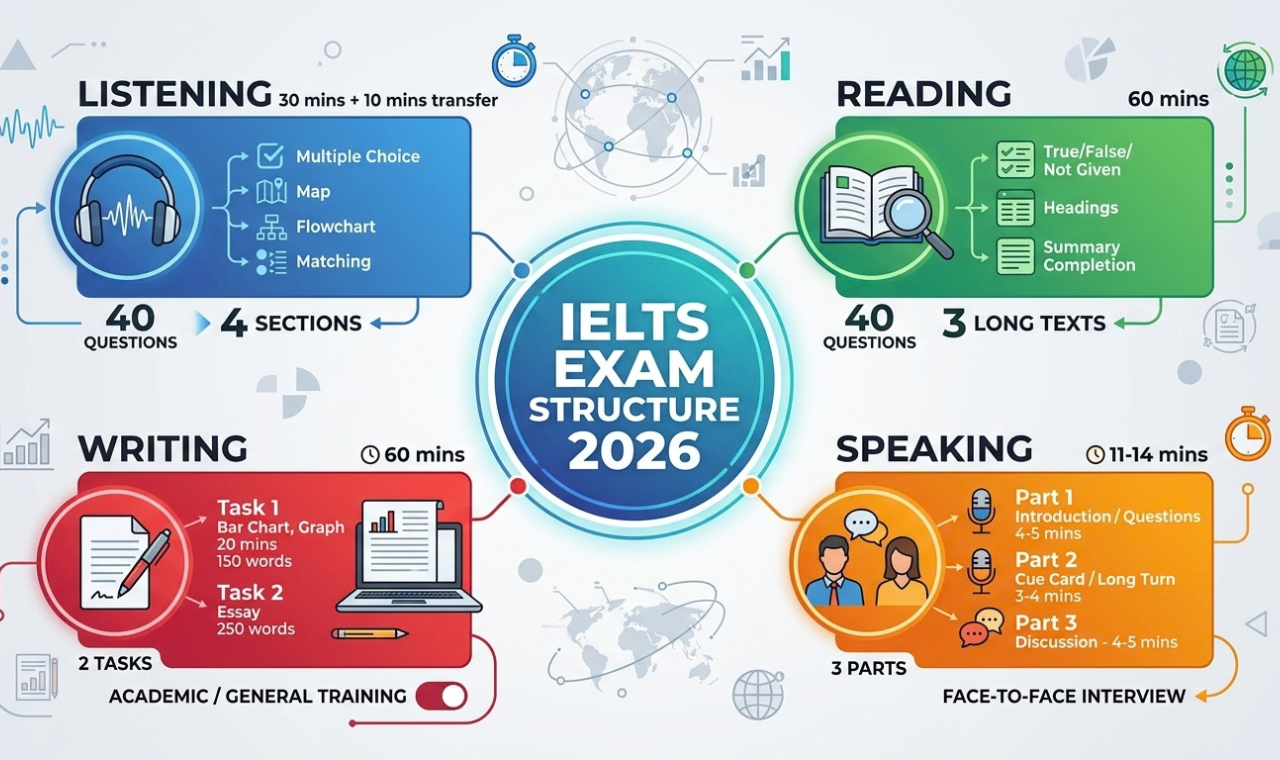
IELTS speaking module is 11-15 minutes long, consisting of three parts in which the examiner asks questions on different topics. Here’s a brief overview of IELTS speaking:
- Part 1: It consists of 5-8 questions on different topics (mostly two topics), and we have to keep our answers of optimum length (4-5 sentences long)
- Part 2: It is also called the cue card section. Where we have 1 minute preparation time, and then we have to answer the question continuously for 1 to 2 minutes without any pause. Remember, the cue card has only one single question.
- Part 3: It has questions related to Part 2, and we have to keep our answers around 4 to 5 sentences long.
CELPIP Speaking Structure:
CELPIP speaking is around 15 to 20 minutes long, comprising 8 different parts. Here’s a brief overview of each part:
- Part 1: We give practical advice or suggestions to a friend or family member facing a specific problem, with 30 seconds of preparation time and 90 seconds to speak.
- Part 2: We tell a story about a past personal experience or situation, with 30 seconds of preparation time and 60 seconds to speak.
- Part 3: We describe a detailed illustration or picture out loud, with 30 seconds of preparation time and 60 seconds to speak.
- Part 4: We use the same picture from Part 3 to guess what will happen next, with 30 seconds of preparation time and 60 seconds to speak.
- Part 5: We choose between two options and persuade someone why our choice is better, with 60 seconds of preparation time and 60 seconds to speak.
- Part 6: We handle a challenging situation such as making an apology or resolving a conflict, with 60 seconds of preparation time and 60 seconds to speak.
- Part 7: We express and defend our opinion on a social or community topic, with 30 seconds of preparation time and 90 seconds to speak.
- Part 8: We describe a complex or unusual object shown on screen to someone who cannot see it, with 30 seconds of preparation time and 60 seconds to speak.
Is CELPIP speaking easier than IELTS speaking?
Straight forward answer is NO. IELTS speaking is easier than CELPIP due to the reasons highlighted in the table below:
| Features | IELTS Speaking | CELPIP Speaking |
| Test Interaction Style | 1-on-1 with a human examiner | Totally computer-based with no human involvement |
| Question Types | Simpler: back-to-back straightforward questioning and answering | Complex: Each part is different and requires specific techniques for higher scores |
| Visual Tasks | None | In some questions, you have to describe an image |
| Test Time | Flexible: 11-15 minutes and three parts | Restricted: 15-20 minutes, and we have to answer each question within a specific time |
It is true that due to no human involvement in CELPIP, many students with poor confidence and public speaking skills may find the interaction method of CELPIP easier than IELTS. However, if we look at each part, then IELTS is quite simple because we don’t have to memorise certain phrases and learn task or part-specific grammar as in CELPIP, which makes CELPIP much more difficult to prepare.
Therefore, I would say that IELTS speaking is easier than CELPIP due to its simpler question types, and there is no need to learn specific grammar and phrases for each part.
Difficulty Level of Each Module of IELTS and CELPIP:
On the basis of the above discussion and points we mentioned in each module for both tests, here’s the level of difficulty of each module:
- IELTS Listening:
Easy - CELPIP Listening: Hard
- IELTS Reading:
Easy - CELPIP Reading: Hard
- IELTS Writing: Hard
- CELPIP Writing:
Easy - IELTS Speaking:
Easy - CELPIP Speaking: Hard
Preparation Resources:
Both tests have some free and paid resources that can help you to prepare for the exam and achieve your desired scores:
(i) IELTS: For IELTS preparation, you can take help from Liz IELTS and solve Free GT Mock Tests from here. Moreover, Cambridge IELTS Books is one of the biggest and most authentic practice resources.
(ii) CELPIP: CELPIP has a dearth of free resources. Most websites with practice exams are either unauthentic or do not have the same difficulty level as the actual exam. Only one resource is available that is authentic and updated regularly: CELPIP Official Tests.
Therefore, a lack of authentic practice resources for CELPIP could be another reason you should prefer IELTS over the CELPIP exam.
Final Verdict: Is IELTS Easier than CELPIP?
After the points I have given above for each module, I can confidently say that IELTS is much easier than CELPIP when it comes to question types and overall format of the test.
Frequently Asked Questions
Yes. The content concludes that IELTS is generally easier than CELPIP because it has simpler question types, more flexible timing, and does not require candidates to learn part-specific grammar or phrases.
IELTS is available in paper and computer-based formats in some locations and is widely accepted internationally, while CELPIP is fully computerised and is mainly accepted in Canada. Their scoring systems also differ: IELTS uses bands up to 9, while CELPIP uses levels up to 12.
Yes, IELTS Listening has a simpler format, takes about 30 minutes, allows candidates to see questions before listening, and does not impose a fixed time limit on individual questions.
Yes. Although IELTS reading content can be more complex, its sections are not individually time-bound. CELPIP assigns specific time limits to each part, and candidates cannot return to a previous part after its time has ended.
CELPIP Writing is easier because both tasks require 150–200 words, the topics are considered simpler, and the computer-based test provides features such as spell check, copy/paste, undo, and a word counter.
Yes. IELTS Speaking has three relatively straightforward parts with a human examiner, whereas CELPIP Speaking has eight different parts with specific tasks and time limits. The content therefore considers IELTS Speaking easier to prepare for.
IELTS takes approximately 2 hours and 45 minutes in total, while CELPIP takes almost 3 hours. The exact timing varies between individual modules and test formats.
An IELTS 6.5 is generally equivalent to CELPIP 7. However, the exact comparison can vary by skill and by the purpose of the test. For Canadian immigration, IELTS 6.5 corresponds to CLB 8 in Reading, Writing, and Speaking, while IELTS Listening 6.5 falls between the listed CLB levels.
Both CELPIP General and IELTS General Training are accepted by IRCC for Canadian permanent residence programs, including Express Entry. Therefore, neither test is universally better for PR. Your choice should depend on the requirements of your immigration program, your strengths, and which test format you find easier.
Both tests are valid for 2 years.

Written By: Hamza Ahmad
I’m an English language trainer with 3+ years of experience in IELTS, helping students achieve scores as high as an 8.0 overall band. A published contributor to Modern English Teacher (MET), I founded IELTS Prep and Practice to help students hit their target scores through proven strategies and personalized coaching.
Contact Now