Canada offers multiple immigration streams for individuals on the basis of their profession or field. Each stream or program has different English language proficiency requirements. This article will guide you on the IELTS score you need to move to Canada.
Firstly, you need to decide whether you will move to Canada as a student, for work, or permanently through Express Entry. Each one of these options has certain requirements in terms of education, profession, and work experience. Once you have decided on the route you will take, you should look for the IELTS band score requirement and start IELTS preparation.
The following are the most common pathways that are chosen by people from different countries to immigrate to Canada, along with the required IELTS scores.
1- Moving to Canada as a student:
If you decide to immigrate to Canada as a student, then you need to take the SDS or Non-SDS route.
- Student Direct Stream (SDS): The IELTS requirement for SDS is a score of 6.0 or higher in each language ability (Listening, Reading, Writing, and Speaking).
- Non-SDS route: There is no fixed requirement for IELTS in this case. However, you must meet the minimum English language requirement as demanded by the DLI or the institution to which you are applying.
2- Moving to Canada on a Work Visa:
A work visa allows workers from worldwide to earn a living while staying in Canada for a fixed period of time under specific conditions. There are two categories of work visas:
(i) IELTS Requirement for Employer-Specific Work Permit:
This primarily depends on getting a valid job offer, LIMIA, and then applying for a work permit. The IELTS band score requirement for an open work permit depends on the employer. Generally, IELTS is not needed, and the employer cannot make it mandatory to show IELTS.
In case of high-demand jobs such as business, engineering, and research-related fields, IELTS can be asked by the employer. On the other hand, in case of farm or agriculture-related jobs, IELTS is not required.
(ii) IELTS Requirement for Closed Work Permit:
This mostly covers the post-graduate work visa, spouse visas, and other types of professional and non-professional jobs. LIMIA is not mandatory, but IELTS can be demanded on the basis of the visa stream.
Key difference between employer-specific and open work permit:
Below are the key differences between the two types of work permits:
| Employer specific | Open Work Permit | |
| IELTS requirement | Not needed | Mostly needed |
| LIMIA | Mostly Necessary | Not required |
| Processing Fees | The employer may ask for processing or application fees | Employer does not have to pay any fees |
| Types of work streams/visas, work included | Agriculture workers, Global Skills Strategy, and International Experience Canada | PGWP, Spouse Visa, Asylum seekers, Travel and Work Visa, Investors, Vulnerable people |
| Job offer | Mostly Required | Not required |
3- Moving to Canada permanently through Express Entry
Canada has an online application management system called Express Entry through which the manage the applications for permanent residency, depending on your age, education, professional work experience, and other factors. Under this management system, the Canadian immigration department is managing three different pathways, explained below:
1. IELTS Requirement for Federal Skilled Worker Program (FSWP)
This program is designed for workers who do not have Canadian work experience on the basis of their education, professional experience (paid), and proficiency in English and French languages.
The minimum requirement for English language proficiency is CLB 7 across all 4 abilities. On IELTS GT, CLB 7 corresponds to 6.0 in each of Speaking, Listening, Reading, and Writing.
2. IELTS Requirement for Federal Skilled Trades Program (FSTP)
This program allows people with specialized knowledge and hands-on experience in the field of:
- construction
- transportation
- manufacturing and industrial
- natural resources and agriculture
The minimum IELTS GT scores required for this program are CLB 5 in speaking and listening, and CLB 4 in the other two modules, like this:
- Speaking and Listening: 5.0 bands
- Reading and Writing: 3.0 bands in Reading and 4.0 bands in Writing
3. IELTS Requirement for Canadian Experience Class (CEC)
CEC is designed for students who have Canadian work experience of at least one year during the last 3 years, and this program basically supports students who are on a post-graduate work permit.
The minimum IELTS GT scores depend on the NOC TEER category of your job:
- TEER 0 or 1 (CLB 7): 6.0 in all 4 abilities
- TEER 2 or 3 (CLB 5): 4.0 in Reading and 5.0 in the remaining modules
Here’s a short overview of the IELTS requirement for three types of immigration pathways under Express Entry:
| FSWP | FSTP | CEC | |
| IELTS Requirement | Need 6 Bands or CLB 7 in IELTS in all modules | Needs CLB 5 or 5 Bands in IELTS in speaking and listening with 3 Bands in Reading, and 4 Bands in writing | TEER 0-1 needs 6 bands in all four modules in IELTS. TEER 2-3 needs 4 bands in Reading and 5 bands in other modules of the IELTS exam. |
4. Atlantic Immigration Program (AIP)
This program is designed for students who have graduated from Canadian institutions or are skilled workers and want to work in one of the Atlantic provinces. To be eligible, you must meet the language proficiency requirement, have a job offer, and have professional work experience.
IELTS score requirement for AIP:
The minimum CLB level required depends on your job offer’s TEER category:
- TEER 0, 1, 2, or 3: CLB 5 equals 5.0 in Speaking & Listening, 4.0 in Reading, and 5.0 in Writing in IELTS GT
- TEER 4: CLB 4 → IELTS GT: 4.0 in Speaking, 4.5 in Listening, 3.5 in Reading, 4.0 in Writing
5. Rural Community Immigration Pilot (RCIP)
The Rural and northern immigration pilot program is a permanent residency program designed to hire foreign workers in remote areas of Canada where the labor requirement cannot be fulfilled by the local workers.
IELTS score requirement for RNIP:
The minimum language requirements vary by job offer TEER category:
- TEER 0 or 1: CLB 6 → IELTS GT: 5.5 in all modules except Reading, in which 5 bands are required.
- TEER 2 or 3: CLB 5 → IELTS GT: 5.0 in all modules except Reading, in which 4 bands are required.
- TEER 4 or 5: CLB 4 → IELTS GT: 4.0 in Speaking, 4.5 in Listening, 3.5 in Reading, 4.0 in Writing
5. Start IELTS GT preparation:
Once you have decided on the immigration pathway that you will choose, then you should check how high an IELTS score you would need to have a successful application, apart from the minimum eligibility score requirement.
According to your profile, you should target a specific score and make a preparation plan according to that. Gather preparation resources such as Cambridge IELTS books and start practicing daily. Here’s a detailed blog on achieving 8,7,7,7 in IELTS General Training.
Remember, when you start preparing for IELTS, you must do it regularly if you really want to achieve your desired scores. Also, after doing a certain test, let’s say of listening, you should do the incorrect questions again, to find out your mistakes.
Conclusion
Moving to Canada as a student or permanently relies on your performance in IELTS. You should aim for a higher score so that you can immigrate to Canada for study, work, or on a permanent basis. Therefore, set a target score, gather preparation resources, make a study plan, and start doing hard work to achieve your dream of moving to Canada.
Last Updated 28 June 2026
Frequently asked questions
No. Only IELTS General Training (GT) is accepted for Express Entry not Academic.
Not necessarily. Express Entry needs 6.0 in each of the four modules (Listening, Reading, Writing, Speaking), not an overall average. If your overall 6.0 came from mixed scores (e.g., 5.5 in one module), you don’t meet CLB 7 and can’t apply through FSWP. Also, for a successful Express Entry application, you should aim for 8,7,7,7.
Cambridge IELTS practice test books, British Council/IDP’s official “Road to IELTS,” and GT tests are available on the IPP website.
Cambridge Academic practice test books, British Council’s official Academic prep materials, and IPP academic tests.
Typically 4–8 weeks of focused daily practice, depending on your starting level and target band.
It would be CLB 7. For further conversions of other band scores, check this table: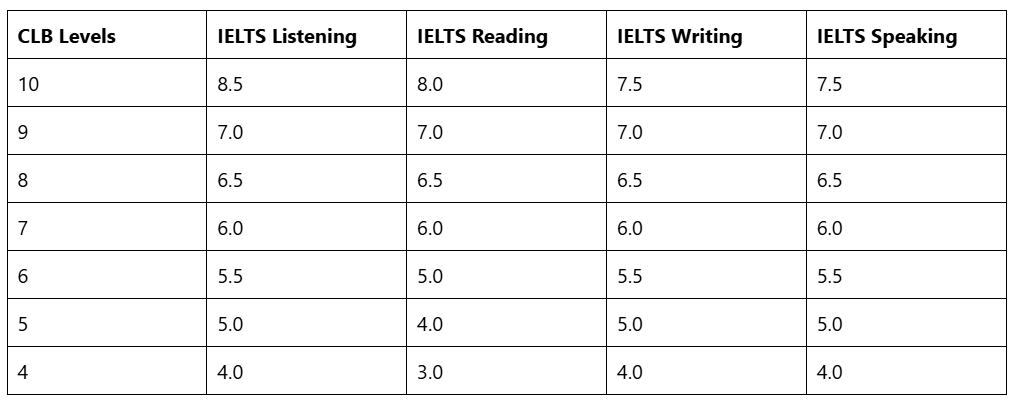
There is no clear answer. It depends on the person. CELPIP is computer-based only, uses Canadian English/context, and some find its format more predictable, while IELTS is more globally standardized and has a paper option. Neither is objectively easier. For a more detailed comparison, check this blog.
Yes, generally. Academic Reading and Writing use more complex academic texts and essay tasks; GT’s Reading/Writing are more everyday/workplace-focused and considered slightly easier. Listening and Speaking are identical in both versions.

Written By: Hamza Ahmad
I’m an English language trainer with 3+ years of experience in IELTS, helping students achieve scores as high as an 8.0 overall band. A published contributor to Modern English Teacher (MET), I founded IELTS Prep and Practice to help students hit their target scores through proven strategies and personalized coaching.
Contact Now